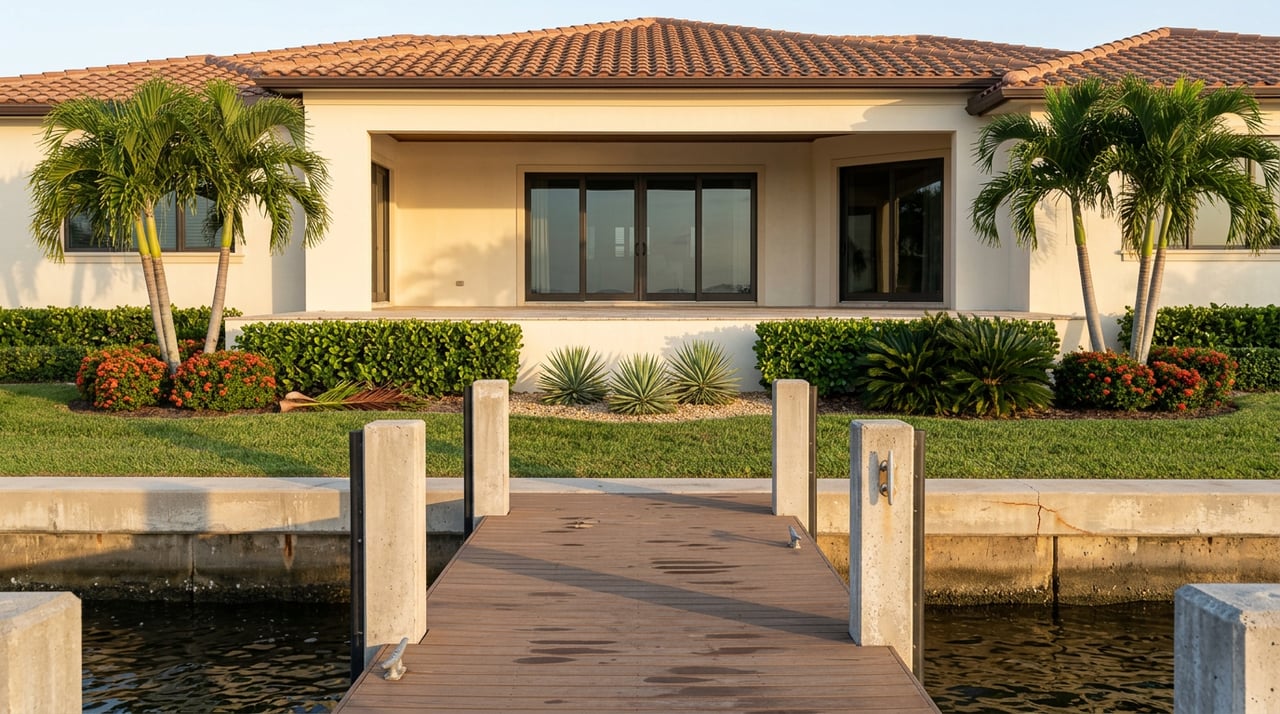
Picture a seller on one of Lighthouse Point's canal streets who spent a weekend last spring patching a crumbling section of seawall cap before listing the house. A cracked panel, some exposed rebar, a contractor who quoted a straightforward fix. Nothing that felt like a big deal. Then an inspector pulling permit history for the buyer's title company asks a different question: how much of the wall, by linear footage, did that repair actually touch. If the answer comes back at half or more, the seller isn't just fixing a panel anymore. Under the framework that governs Broward County's waterfront cities, crossing that line can mean the entire seawall has to meet current elevation standards, not just the section that got new concrete.
That's the friction most listing sheets never mention, and it's the reason a seawall in good working order on the day of the walkthrough can still turn into a six-figure conversation before closing.
The Repair That Isn't Just a Repair
Broward County's regional standard for tidal flood barriers is set out under Policy 2.21.7 and Chapter 39, Article XXV of the county code, and it applies to new construction and to substantial repairs alike. Fort Lauderdale has layered its own stricter local minimum of 5.0 feet NAVD88 on top of that county baseline, which means two homes on the same finger canal system, one just across a city line from the other, can face different elevation requirements for what looks like the identical wall.
What actually triggers compliance isn't a future deadline. As Alex Ray, co-owner of the Pompano Beach marine construction firm South Florida Seawall, put it in a May 2026 announcement about the rule: "It's the day an owner decides to fix more than half of their wall." Homeowners who assume they have until some far-off year to deal with an aging seawall are working from the wrong calendar. The clock starts the moment a repair crosses that threshold, whether or not anyone planned for it.
What the City Actually Asks to See
Lighthouse Point's own building department publishes a permit checklist for docks, seawalls, and boat lifts, and it reads less like a formality and more like a coordination problem. A permit package generally needs a building application, an electrical application where applicable, two sets of outside-agency approvals from Broward County, the Florida Department of Environmental Protection, or the Army Corps of Engineers, and signed and sealed engineering plans for stringer, framing, or concrete dock work. For new residences or major additions, that same review can require two signed and sealed engineer letters confirming the seawall's condition and whether it can support the added upland improvements, specifically when a project adds or remodels 50 percent or more of the structure.
One line in that checklist is easy to miss and says a lot about how this market actually works: contractors need updated registration that includes Longshoreman's insurance under federal law, because any crew working over navigable water falls under a different labor statute than a crew working on dry land. It's a small detail, but it's the kind of detail that tells you this isn't a generic home renovation process. It's a marine construction process wearing a residential permit's clothing.
The Canal Project Nobody Put on the Listing Sheet
Seawalls aren't the only moving part. The City of Lighthouse Point ran its own multi-phase canal dredging program starting in mid-October 2024, with a second phase scheduled to begin as soon as the first wrapped, a process the city estimated would take roughly six months on its own. Programs like that reset canal depth citywide, which matters directly to anyone buying a home for the boat that's supposed to live at the dock. A listing photo of a seawall and a cleat doesn't tell you what the water depth looks like at low tide today, and depth is the kind of thing that changes on a timeline the MLS doesn't track.
Three Numbers, One Thin Market
Anyone comparing price data on Lighthouse Point right now will notice the numbers don't agree with each other, and that disagreement is itself useful information.
| Source and window | Figure | What it's actually measuring |
|---|---|---|
| Zillow's home value index, as of July 31, 2026 | $771,700 average, up 0.6% year over year | A blended estimate across every home in the city, waterfront and inland alike |
| Closed sales, three months ending May 2026 | $974,417 median, 89 median days on market | Actual transacted homes over a rolling quarter |
| Closed sales, single month of February 2026 | $1.1425 million median, 83 median days on market | A one-month snapshot, smaller sample, more exposed to a handful of large deals |
| Trophy tier ($5 million and above), Q2 2026 | One closed sale at $6.0 million | The very top of the market, where a single transaction is the entire quarter's data |
None of these figures is wrong. They're measuring different slices of a market that, according to a mid-August 2026 count of active listings, has 183 properties on the market spanning $675,000 to $15.95 million for single-family homes alone. When the pool of comparable sales is that small at the top end, one closing can move the median more than it would in a market with hundreds of monthly transactions. That's why a seller pricing off a citywide average, or a buyer assuming last quarter's median tells them what a specific stretch of seawall is worth, is working from a number that was never built to answer that question.
Why the Address Inside the Address Matters
Lighthouse Point wasn't built as one uniform grid. The subdivisions of Venetian Isles, Lighthouse Manor, Coral Key, Wooler Heights, and Pompano Waterway Estates were added to the city through the late 1950s and early 1960s, each with its own canal geometry, bridge situation, and dockage character. A home's value has as much to do with which of those original sections it sits in, and what the seawall and canal width in that specific pocket allow, as it does with the citywide median.
Some buyers weigh private dockage against the alternative of a slip at Port 32 Lighthouse Point Marina, which advertises accommodations up to 80 feet and Florida Clean Marina status, or a membership at the Lighthouse Point Yacht & Racquet Club, which offers ten Har-Tru tennis courts, a fitness center, and its own marina. Those amenities don't show up in a home's price per square foot, but they shape what a given dock is actually worth to the person buying it.
Before You Sign: A Working Checklist
For anyone under contract, or about to be, on a canal-front Lighthouse Point property, a few questions are worth asking before the inspection period closes rather than after:
- Pull the permit history yourself, not just the survey the seller provides. The city's own building department can confirm what's open, closed, or missing.
- Ask for the top-of-seawall elevation stated in NAVD88, not just "feet above the water," since NAVD88 is the fixed benchmark inspectors and engineers actually use.
- If any documented repair work touches 50 percent or more of the wall's linear footage, request the signed and sealed engineer letters confirming current condition and capacity.
- Confirm whether the dock, lift, or seawall work required sign-off from Broward County, FDEP, or the Army Corps of Engineers, and whether that sign-off is on file.
- Get a current sounding at the dock and at the canal entrance at mean low water, especially on canals near recent dredging activity.
- Check the date on the property survey. If it's more than a year old, the city's zoning affidavit requirement kicks in for any new permit work.
None of these steps changes what a home is worth. They change whether the number both sides agreed to survives the weeks between contract and closing.
The Wall Doesn't Know How Much You Meant to Fix
A seawall doesn't distinguish between a planned upgrade and an accidental one. Once a repair crosses the halfway mark, the county's standard applies to the whole structure, regardless of what the original scope of work was supposed to be. That's the detail that separates a Lighthouse Point closing that goes smoothly from one that stalls in the last thirty days over an elevation certificate nobody asked for at the start.
Frequently Asked Questions
Does every seawall in Lighthouse Point have to be raised to a new height right now? No. There's no blanket mandate forcing every wall to a new elevation on a fixed date. The requirement attaches to new construction and to repairs that cross the substantial-repair threshold, which in practice means the trigger is a decision, not a deadline.
Why do Fort Lauderdale and Lighthouse Point apply different standards to what's basically the same canal system? Because the county sets a baseline under Policy 2.21.7 and Chapter 39, Article XXV, and individual cities can adopt stricter local rules on top of it. Fort Lauderdale has done that at 5.0 feet NAVD88. Whether a given Lighthouse Point property follows the county baseline or a city-specific rule is exactly the kind of thing worth confirming with the building department before assuming either way.
What is NAVD88 and why does it matter more than "feet above the water"? NAVD88 is the North American Vertical Datum of 1988, a fixed surveying benchmark rather than a tide-dependent measurement. Because it doesn't move with the tide, it's the reference engineers, surveyors, and permit reviewers actually use when comparing a seawall's height to the current standard.
If you're weighing a purchase or a sale on Lighthouse Point's canals and want someone who reads the permit history before the offer goes in, not after, Linda Hoyt has spent more than two decades working these exact waterways. Request Your Personalized Market Valuation to start the conversation before the seawall does.